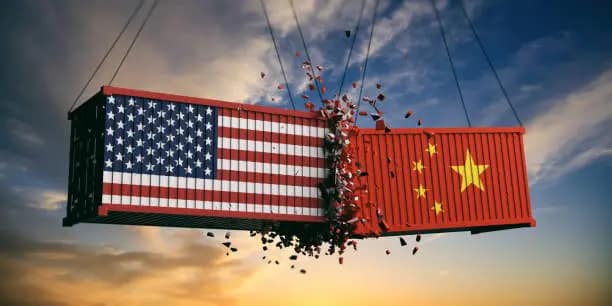
The US–China trade war is heating up, shaking global markets and raising fears of a slowdown. Investors are bracing for major economic impacts worldwide.

A New Chapter in Global Trade Tensions
The global economy is facing growing uncertainty as the U.S.–China trade war intensifies. Tensions between the world’s two largest economies have reached a new level, with Washington announcing additional tariffs and Beijing responding with countermeasures.
Investors worldwide are now bracing for market volatility, as both governments signal that the conflict could drag on longer than expected. Analysts warn that the standoff may become a “new normal” for global trade, impacting everything from supply chains to commodity prices.
How It Started: A Quick Breakdown
Think of the U.S. and China as two big stores that trade with each other every day. When they argue and put “extra fees” (tariffs) on each other’s goods, it makes everything more expensive.
- The U.S. government recently raised tariffs on a new list of Chinese goods.
- China responded with retaliatory tariffs and tighter export controls.
- These moves make it more expensive for companies to buy and sell, which can slow down the economy.
For everyday people, this could mean higher prices on consumer goods, slower job growth, and less certainty in the markets.
Market Reactions: Fear Creeping In
The Dow Jones Industrial Average, S&P 500, and Nasdaq Composite saw sharp intraday moves as traders reacted to the latest announcements. Shares of major manufacturing, technology, and logistics companies fell, while gold prices rose — a classic sign of investors moving toward safe-haven assets.
“The trade conflict has entered a more dangerous phase,” said one Wall Street analyst. “This isn’t just a short-term headline anymore — it’s shaping the direction of the global economy.”
U.S. Impact: Higher Costs and Slower Growth
American businesses that depend on imported components from China are feeling the squeeze. Companies in electronics, retail, and auto manufacturing are warning of higher input costs, which could eventually be passed on to consumers.
Economists say the tariffs could:
- Slow down U.S. manufacturing activity.
- Increase prices for consumer goods.
- Put pressure on corporate earnings.
Some businesses are exploring alternative supply chains, but experts say it’s not easy to replace China overnight.
🇨🇳 China’s Response: Strategic Countermoves
China has also fired back. Beijing announced:
- Retaliatory tariffs on key U.S. exports
- Tightened restrictions on critical rare-earth minerals
- New trade deals with other countries to reduce dependence on the U.S.
This strategic shift shows China is preparing for a long-term economic battle — not just a temporary fight.
Global Ripple Effects
The trade war doesn’t just affect the U.S. and China — it sends shockwaves across the world:
- Emerging markets may see lower export demand.
- Global supply chains could become more expensive and unstable.
- Commodity prices like oil, copper, and soybeans may stay volatile.
- Currency markets could see more unpredictable swings.
Economies in Europe, Latin America, and Southeast Asia are already reporting early signs of trade slowdown linked to the U.S.–China standoff.
Investors Move to Safe Havens
With market uncertainty rising, investors are rushing toward gold, U.S. Treasuries, and other safe-haven assets.
- Gold hit its highest level in months.
- Bond yields are declining as investors seek safety.
- The U.S. dollar strengthened slightly, reflecting global demand for stable assets.
This flight to safety is a typical market reaction during trade tensions, signaling that confidence is weakening.
What Experts Are Saying
Economists and market strategists believe this trade war could become a long-term structural challenge rather than a short-term political fight.
- “This is not a one-week story anymore,” said a trade strategist.
- “Companies are rethinking their entire global supply chain strategies,” added another expert.
- “The world may be entering a new economic era where trade wars are the norm, not the exception.”
What to Watch Next
- Next Round of Negotiations — Any sign of a truce could spark a rally, but more escalation could push markets lower.
- Earnings Season Impact — Watch how companies report trade-related costs.
- Commodity & Currency Trends — These give early warning signs of deeper market stress.
- Fed Policy Signals — The Federal Reserve may face pressure to adjust rates if trade tensions hit growth. This Matters
- When two big economies fight, prices can go up, business slows, and investors panic.
- The U.S.–China trade war isn’t just about politics — it affects jobs, prices, and investments worldwide.
- If it continues, markets could remain shaky for months.
Final Thoughts
The escalating U.S.–China trade war is more than just a headline — it’s shaping the future of the global economy. For investors, businesses, and policymakers, the coming weeks will be critical. Whether tensions ease or intensify further could determine how stable global markets remain heading into 2026.

Leave a Reply