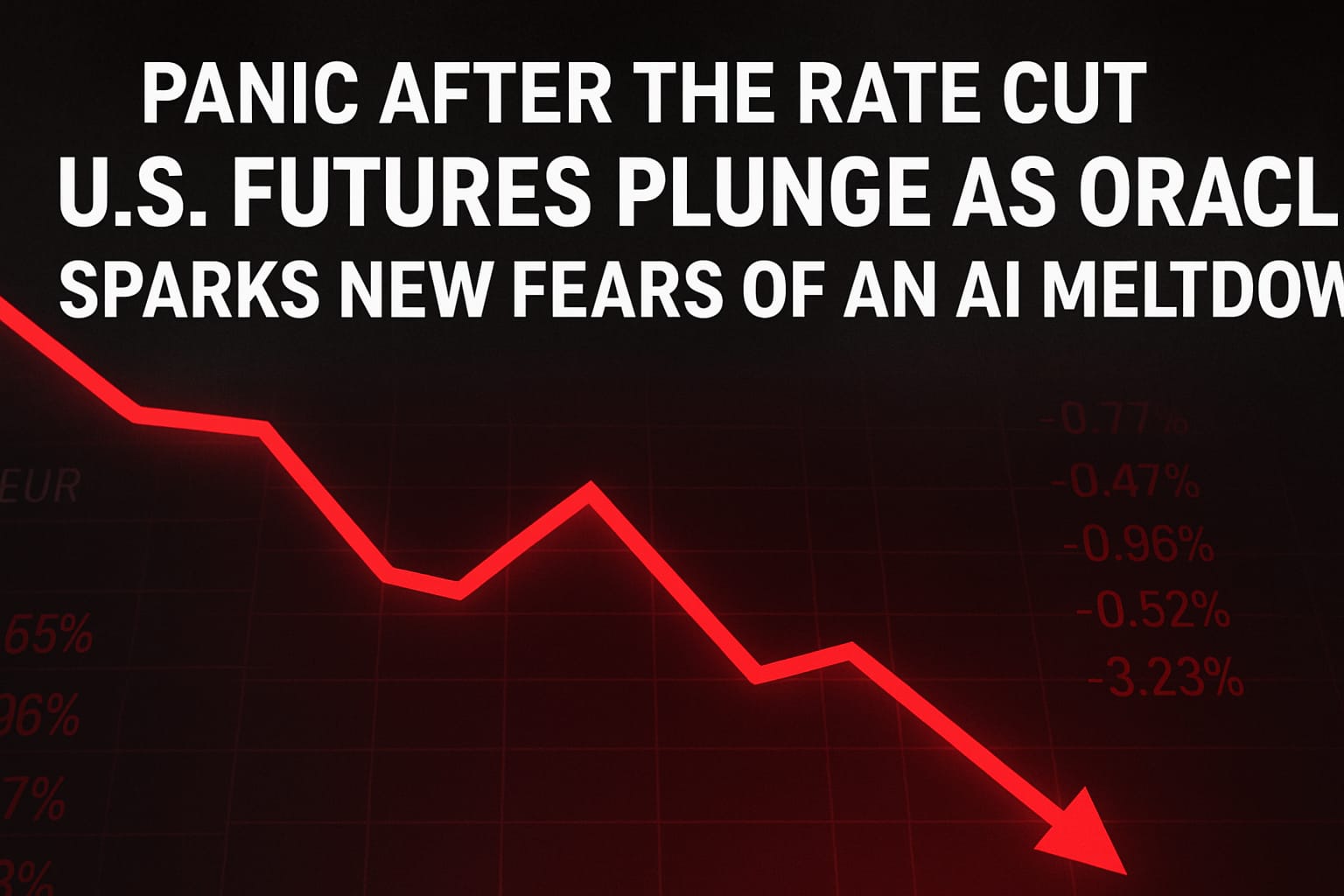
U.S. stock futures fall despite the Fed’s rate cut as Oracle’s weak results fuel new fears of an AI slowdown. Here’s what investors need to know about today’s market panic and why Wall Street is bracing for more volatility.
📉 Market Panic Hits Wall Street After the Fed’s Rate Cut
The U.S. financial markets woke up to fresh turbulence today as stock futures turned sharply lower, despite the Federal Reserve delivering a widely expected rate cut. Normally, a rate cut brings relief — cheaper borrowing costs, stronger business confidence, and rising equity prices.
But this time, Wall Street didn’t celebrate. Instead, markets reacted with fear.
The trigger? Oracle’s earnings report, which delivered a painful blow to the soaring expectations surrounding the artificial intelligence (AI) boom. For investors already nervous about the Fed’s signals and the broader economic landscape, Oracle’s numbers added another layer of stress — one that markets couldn’t ignore.
😨 Oracle’s Weak Results Ignite AI Meltdown Fears
The AI sector has been the engine driving U.S. markets for nearly two years. Tech giants, chipmakers, cloud companies, and large enterprise software firms have seen massive valuations, all fueled by hopes that AI spending would continue accelerating.
Oracle’s earnings shattered that assumption.
Instead of strong growth in cloud and AI-related services, the company posted weaker-than-expected results, signaling that AI spending might be slowing sooner than markets anticipated.
For an industry priced for perfection, even a small miss is enough to shake confidence — and Oracle’s report did more than that. It raised the terrifying question:
Is the AI boom cooling faster than Wall Street expected?
This uncertainty spread quickly across futures markets, dragging down tech heavyweights even before the opening bell.
📉 U.S. Stock Futures Fall Across the Board
By early morning, all three major U.S. index futures were deep in negative territory:
- Dow Jones futures: lower
- S&P 500 futures: sharply down
- Nasdaq futures: under heavy pressure, hit hardest due to tech exposure
The reaction shows just how fragile market sentiment has become. A single disappointing earnings report was enough to overpower the usual optimism that follows a rate cut.
Investors who expected a rally instead faced a sharp sell-off.
📉 Why the Fed’s Rate Cut Didn’t Calm Markets
The Federal Reserve cut interest rates to help stimulate an economy losing momentum heading into the final stretch of the year. Rate cuts typically lift markets, but this one didn’t land the way investors expected.
Here’s why:
1. Investors wanted clarity — but got uncertainty
The Fed didn’t firmly commit to more cuts. Instead, it signaled a “data-dependent” approach, leaving markets unsure whether more relief is coming.
2. Economic concerns remain
Even with lower rates, investors are still worried about weakening consumer spending, slowing corporate investment, and global economic pressures.
3. AI stocks were already vulnerable
Many AI-linked companies were priced for extremely high growth. Oracle’s miss exposed how fragile those expectations are.
So instead of confidence, the rate cut created confusion — and markets hate uncertainty.
🔥 The AI Sector Faces a Reality Check
The U.S. stock market’s multi-year rally has been heavily powered by mega-cap tech companies riding the AI wave. Companies such as Nvidia, Microsoft, Amazon, and Alphabet have delivered explosive gains, becoming the pillars of the S&P 500.
But Oracle’s results suggest something deeper:
AI adoption may be strong, but AI spending isn’t infinite — and some firms are pulling back.
This is the first major sign that enterprise-level AI investment may be slowing. If this trend continues, it could trigger a broader repricing of tech valuations.
That’s why Wall Street is reacting so aggressively.
🔍 What Investors Should Watch Next
As markets adjust to this shock, three critical factors will determine where stocks go from here:
1. Forward guidance from major tech companies
If more AI-linked companies begin lowering expectations, markets could enter a deeper correction.
2. Federal Reserve comments in the coming weeks
Any hints of future cuts — or hesitation — will heavily influence investor sentiment.
3. Consumer and labor market data
If U.S. household spending softens further, growth stocks could face even more pressure.
📊 Short-Term Outlook: Volatility Ahead
Between the Fed’s uncertain path and the sudden doubts about AI growth, volatility is almost guaranteed. Investors may see sharper intraday swings, sector rotations, and renewed caution across high-growth stocks.
In the short term, today’s market behavior shows that fear is back — and it’s spreading fast.
🧭 Final Thoughts
The combination of the Fed’s rate cut and Oracle’s troubling earnings created the perfect storm. Instead of pushing markets higher, the news triggered a wave of questions about economic health, AI spending, and the true strength of corporate America heading into the new year.
For now, one thing is clear:
The AI market is entering a new phase — and Wall Street is no longer willing to overlook weakness.
As U.S. futures fall and uncertainty spreads, investors must prepare for a choppier, more unpredictable market environment.
https://fundrahub.com/category/stock


Leave a Reply